What I work on
Economic development policy in Hawaiʻi
Hawaiʻi's economy is highly specialized and has grown slowly for decades. I work on understanding its economic performance while accounting for local prices, identifying where it could realistically diversify, and designing tailored economic policies to support growth and diversification.
Publications on this theme are listed below. A complete list of journal articles is on the research page. A full list of authored reports written for governments and other public audiences is on the reports page. Shorter writing for a general audience is on the commentary page.



-
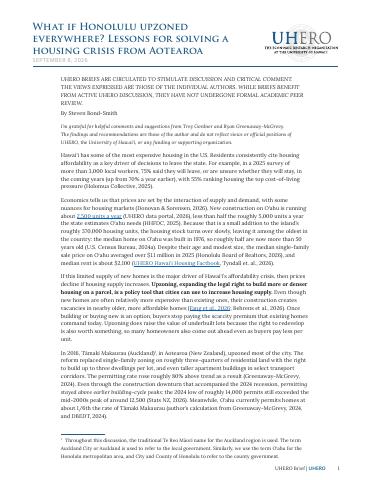
What if Honolulu upzoned everywhere? Lessons for solving a housing crisis from Aotearoa
UHERO Brief, 2026
-

What if Honolulu upzoned everywhere? Lessons for solving a housing crisis from Aotearoa
UHERO Insights, 2026
-
Are people leaving Hawaiʻi because of high prices, or low incomes?
UHERO Insights, 2026
In the pressHawaiʻi Free Press, KHON2 News, University of Hawaiʻi News, National Today
-
The lost decade never ended in Hawaiʻi
UHERO Insights, 2026
In the pressHawaiʻi Free Press, El-Balad, University of Hawaiʻi News
-
Beyond the price of paradise: Is Hawaiʻi being left behind?
UHERO Report, 2026
Supported by the Hawaiʻi Business Roundtable
Published version UHERO Insights UHERO Focus video
In the pressThe Wall Street Journal, SFGate, Aloha State Daily, Honolulu Civil Beat, Hawaii News Now, KITV News, Pacific Business News, Maui Now, Aloha State Daily, Kauaʻi Now, Big Island Video News, AsAmNews, Prism News, Hoodline, KHON2 News, University of Hawaiʻi News, Honolulu Star-Advertiser
-
Reassessing regional club convergence with income adjusted for subnational price variation
Forthcoming at Papers in Regional Science, 2026
-
Estimating a CPI-based regional price parity index for US cities
Urban Studies, 2026
Abstract
Geographic price differences confound comparisons of economic performance across cities by conflating nominal urban advantages with real differences in well-being. Existing tools only partially address this problem: the Bureau of Economic Analysis publishes a Regional Price Parity (RPP) Index that represents relative price levels in US cities and states, but it is available only annually since 2008 and with a publication lag, limiting its usefulness for historical or high- frequency analysis. To address this measurement gap, we use the Consumer Price Index (CPI) for 29 US cities to construct a CPI-based RPP, enabling consistent comparisons of urban economic performance over time at constant and comparable prices. We exploit standard price-parity properties using publicly available CPI data to estimate CPI-based RPPs at a higher frequency and over longer historical horizons. This results in a CPI-based RPP for any period with published CPI data, as far back as 1913 in some cities to the most recent observations. By separating nominal urban advantages from cost-of-living differences, the index allows researchers to reassess claims about urban well-being, affordability, and the real returns to agglomeration. We demonstrate the index by examining long-run regional price dynamics and comparing real per capita GDP and real per capita personal income across cities at constant and comparable prices.
Published version Working paper (PDF) Interactive data tool: CPI-based RPP estimates
-
Building resilient island economies: Policy design lessons from Hawaiʻi
Forthcoming at Competition and Regional Economic Integration Challenges for Small Island Economies Conference Proceedings, 2026
Abstract
Hawaiʻi's dependence on tourism has made its economy vulnerable to shocks and long-run stagnation. In response, there is growing interest in diversifying the economy to build resilience and foster new growth. This paper draws on a study using the principle of relatedness to identify diversification opportunities aligned with existing capabilities. However, identifying opportunities is not enough. If an industry has not emerged, some capability it requires is likely missing. The key policy task is to remove barriers to new industries by uncovering and addressing those gaps. While data access may be more limited for other island economies, the same policy design lessons apply, supporting locally tailored initiatives to identify and overcome barriers to growth.
-
Priced in or priced out, left behind or thriving: A price-income decomposition of US intercity migration
Revisions requested at Cities
-
Measuring the real economic performance of US states: A comparative assessment of deflation methods
Under review
-
Adjusting for cost-of-living differences in regional measures of economic distress
Revisions requested at Economic Development Quarterly
-
Finding opportunities to diversify regional economies with lessons for policy from a case study on Hawaiʻi
Reaching Regions, 1(2), 2025
Abstract
Many regions of the United States promote diversifying their industrial base as a primary goal in regional economic development strategies but rarely use objective tools to identify diversification opportunities and priorities. In this article, we summarize a case study using a novel approach to identify opportunities to diversify Hawaiʻi’s economy and discuss the wider policy implications of this approach for other regions. To explore diversification in Hawaiʻi, we apply the Principle of Relatedness, which predicts regional diversification patterns. We specifically focus on industries that are related because these have a higher probability of thriving. But to diversify, we look for new industries that are currently underperforming. The case study highlights the difficulty of diversifying and the challenges that are likely to face new industries, often requiring a significant policy response to be overcome.
-
Potential opportunities to diversify the economy of Hawaiʻi
UHERO Report, 2024
Published version UHERO Insights
In the pressHonolulu Civil Beat, Maui Now, Honolulu Star-Advertiser, Hawaii News Now, KITV Island News, KITV Island News, Big Island Now, Hawaiʻi Free Press, Kauaʻi Now, Hawaiʻi Public Radio, University of Hawaiʻi News, Hawaii News Now
-
Diversifying Hawaiʻi's specialized economy: A spatial economic perspective
Economic Development Quarterly, 38(1), pp. 40-59, 2024
Abstract
Specialization in tourism exposes the economy of Hawai‘i to external shocks that trigger collapses in tourist numbers. Furthermore, Hawai‘i's economic growth has diminished for decades as the dominance of tourism has not generated productivity growth. In response, policy makers in Hawai‘i increasingly emphasize diversification. This article examines a spatial economics perspective to explain why Hawai‘i is so specialized, and to sketch policy for diversification and growth. Isolated, small, and open economies tend to be more specialized in one or a few industries because increasing returns to scale generates a coordination problem for new industries. By targeting industries that use related know-how, or a Hawai‘i-specific resource, Hawai‘i can access productivity gains from the scale of related and location -bound industries.
Published version Working paper (PDF)
In the pressThe Wall Street Journal, University of Hawaiʻi News
-
Hawaiʻi's long-term economic recovery after COVID-19
UHERO Insights, 2023
-
The effects of the pandemic on the economy of Hawaiʻi
Current Issues in Tourism, 26(23), pp. 3846-3852, 2023
Abstract
Hawaii was vulnerable to the COVID-19 pandemic due to its reliance on tourism. This article analyzes the pandemic’s economic impact in Hawaii by comparing outcomes with the pre-pandemic forecast. We explain why Hawaii’s experience differed from other states, suggest reasons for a slow recovery, and discuss the pandemic’s lasting effects.
-
Is Oʻahu's new Comprehensive Economic Development Strategy strategic enough?
UHERO Insights, 2022
In the pressHonolulu Civil Beat
-
The effects of the pandemic on the economy of Hawaiʻi
UHERO Report, 2022
Prepared for the State of Hawaiʻi Department of Budget and Finance
Not publicly available.
-
Location, location, location: A uniquely Hawaiʻi economic development strategy
UHERO Research Brief, 2021
In the pressHonolulu Star-Advertiser, Hawaiʻi Public Radio, Hawaiʻi Public Radio, The Business Journals, Pacific Business News