Reports
Research for decision makers
Reports written for governments, agencies, community organizations, and a public audience, and the recurring UHERO forecast reports for the state of Hawaiʻi and its counties.
See also: peer-reviewed articles, commentary for a general audience, and press coverage.


Collections
UHERO forecast reports
Quarterly forecasts for the state of Hawaiʻi and its counties, and an annual forecast report for counties, produced with the UHERO forecast team. I write sections on policy and other issues, and edit the reports.
UHERO publications
Reports, briefs, blogs, and videos published by the University of Hawaiʻi Economic Research Organization, apart from the recurring forecasts.
Bankwest Curtin Economics Centre Publications
Reports written between 2016 and 2021 at the Bankwest Curtin Economics Centre in Perth, on the Western Australian economy and on Australian industry, innovation, and higher education.
Filter by topic
Research reports
-
The impact of the hybrid-work-from-home revolution on the performance of UK cities and regions, and implications for transport investments: A synthesis report
The Productivity Institute, 2026
Prepared for the UK Department for Transport
Not yet publicly available.
-
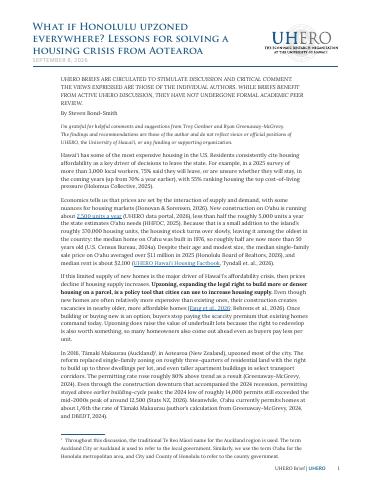
What if Honolulu upzoned everywhere? Lessons for solving a housing crisis from Aotearoa
UHERO Brief, 2026
Summary
In 2016, Auckland, in Aotearoa New Zealand, upzoned ~75% of the city. As a result, permits went up ~80%, and after six years, rents were 22% lower than they otherwise would have been. Auckland’s a useful case study for Honolulu: similar geography, population mix, initial zoning, and affordability. So, a UHERO economist asked: what if Honolulu did the same, and got the same results? Renters would save ~$500/month by 2032 (more for families in 3-bedrooms, $700+) — that’s equal to a ~$8,500/year pay raise per renting household. And most existing homeowners don’t lose out: many gain value from the new right to redevelop. New townhomes are more affordable and replenish the aging housing stock. A rent cut of this size is like a massive pay rise that housing policy can deliver, even when wage growth doesn’t.
-
Beyond the price of paradise: Is Hawaiʻi being left behind?
UHERO Report, 2026
Supported by the Hawaiʻi Business Roundtable
Summary
Hawaiʻi is one of the most desirable—and most expensive—places to live in the world. But for 23 of the past 25 years, more residents have moved to other states than new arrivals have come to the islands. Rhetoric about being “priced out” is usually tied to expensive places where otherwise thriving economies drive gentrification, rising prices, and inequality, pushing middle- and lower-income residents to leave. Hawaiʻi, however, has neither the high incomes nor the extreme inequality of those places. Instead, Hawaiʻi’s experience may more closely resemble economically distressed or “left-behind” regions—marked by stagnant productivity and limited opportunity, though typically with much lower costs of living. In Hawaiʻi’s case, a persistently high relative cost of living may even mask these structural weaknesses and the extent of its economic decline.
So, is Hawaiʻi’s economic distress really about its high cost of living? Or is Hawaiʻi more like left-behind regions with stagnant local economies? Motivated by this puzzle, we re-examine Hawaiʻi’s economic performance by adjusting GDP per capita, per capita personal income, per capita growth, and GDP per hour worked for its high cost of living, revealing a deeper perspective that casts the “price of paradise” in a new light.
The analysis places Hawaiʻi’s economy alongside economically distressed places rather than priced-out metros and shows that its economic distress reflects more than 30 years of lagging per capita growth and productivity, not a rising cost of living, which has remained high but relatively stable compared to other states.
Published version UHERO Insights UHERO Focus video
In the pressThe Wall Street Journal, SFGate, Aloha State Daily, Honolulu Civil Beat, Hawaii News Now, KITV News, Pacific Business News, Maui Now, Aloha State Daily, Kauaʻi Now, Big Island Video News, AsAmNews, Prism News, Hoodline, KHON2 News, University of Hawaiʻi News, Honolulu Star-Advertiser
-
An economic analysis of the proposal to phase out transient vacation rentals in Maui County apartment districts
UHERO Report, 2025
Prepared for the Hawaiʻi Community Foundation
Summary
This report examines the Maui County proposal to phase out transient vacation rentals (TVRs) in Apartment districts, including removing long-standing exceptions for pre-1989 properties widely known as the “Minatoya List.” The policy aims to improve housing affordability, worsened by the 2023 wildfires, by converting TVRs into long-term housing units. Our analysis includes effects on tourism, employment and output, the housing market, and county tax revenues.
In the pressPBS NewsHour, Beat of Hawaii, Associated Press
-

Rural health disparities in Hawaiʻi
UHERO Report, 2024
Prepared for the University of Hawaiʻi Rural Health Policy Research Center
Summary
This report examines the health disparities between rural and non-rural areas in Hawai‘i, using data from the June 2023 UHERO Rapid Survey. While rural areas offer benefits like proximity to nature and strong community ties, they also face challenges such as reduced access to quality healthcare. Our analysis reveals significant health disparities, particularly among people with disabilities and those with low incomes. These findings highlight the need for targeted policy responses to address the unique health challenges faced by rural populations in Hawai‘i.
-

Potential opportunities to diversify the economy of Hawaiʻi
UHERO Report, 2024
Summary
The economy of Hawai‘i is extraordinarily concentrated in the tourism industry. As a result of tourism’s dominance, Hawai‘i’s economy faces short-term risks from shocks that impact visitor numbers and long-term stagnation from flat and volatile tourism spending over the last three decades. In response to these issues—which became especially salient during the COVID-19 pandemic—policymakers in Hawai‘i increasingly emphasize the need to diversify. Still, it is not clear which industries Hawai‘i could diversify into.
Published version UHERO Insights
In the pressHonolulu Civil Beat, Maui Now, Honolulu Star-Advertiser, Hawaii News Now, KITV Island News, KITV Island News, Big Island Now, Hawaiʻi Free Press, Kauaʻi Now, Hawaiʻi Public Radio, University of Hawaiʻi News, Hawaii News Now
-

How does Hawaiʻi's economic geography affect its healthcare industry?
UHERO Report, 2024
Prepared for the University of Hawaiʻi Rural Health Policy Research Center
Summary
Hawai‘i’s small size and isolation present particular challenges to the healthcare industry, including lower productivity and higher costs, due to its limited ability to take advantage of economies of scale. The state’s high cost of living likely compounds these problems by hindering the recruitment of healthcare professionals who must often be hired from out-of-state. Furthermore, national reimbursement policies that fail to reflect regional price or productivity differences in Hawai‘i may also contribute to healthcare service shortages. These issues are potentially even more acute in Hawai‘i’s rural and isolated communities, underscoring the need for evidence-based strategies and policy designs that address the unique challenges facing the healthcare industry in Hawai‘i.
-

After the Maui wildfires: The road ahead
UHERO Report, 2023
Summary
This report takes a high-level view of key recovery issues. At this point, our intent is to identify the scope and scale of impacts already evident and to try to anticipate what the greatest challenges will be. Additional work, together with the Maui community and other experts will be forthcoming in the months and years to come. In that sense this report is intended to initiate an ongoing research agenda to support the people of Maui through this difficult time, and their decision making in the period to come.
-

The economic impact of astronomy in Hawaiʻi: 2019 update
UHERO Report, 2022
Summary
Astronomy continues to be a sizable and stabilizing source of economic activity. In 2019, local astronomy related expenditures in the state totaled $110.02 million with $57.18 million, $35.22 million, $0.28 million, and $17.33 million spent in Hawai‘i, Honolulu, Kaua‘i, and Maui counties respectively. Including indirect and induced benefits and adjusting for inter-county feedback effects, the astronomy sector had a total impact on the output of goods and services in the state of $220.95 million. Astronomy activities also generated $68.05 million in labor income, $10.10 million in state taxes, and 1,313 jobs statewide. The astronomy industry also generates knowledge, expertise, and technology benefits for the wider economy, beyond the direct, indirect, and induced impacts accounted for by the standard economic impact methods. These additional impacts are described as spillovers and underpin the case for public investment in research.
In the pressHonolulu Star-Advertiser, The Business Journals, Pacific Business News, University of Hawaiʻi News
-
The effects of the pandemic on the economy of Hawaiʻi
UHERO Report, 2022
Prepared for the State of Hawaiʻi Department of Budget and Finance
Not publicly available.
-
Location, location, location: A uniquely Hawaiʻi economic development strategy
UHERO Research Brief, 2021
Summary
Hawai‘i’s vulnerability to economic shocks has become a paramount concern during the pandemic. Extreme specialization in the visitor industry exposes Hawaiʻi to risk and volatility when events such as a pandemic, recession or terrorist attack trigger collapses in visitor numbers. In response, policy-makers in Hawaiʻi are placing an increasing emphasis on diversification. Those with an interest in alternative industries are asking for support. Others are justifiably concerned that diversification policy is futile and will support special interests rather than genuine policies to achieve diversification. Tourism is Hawaiʻi’s comparative advantage after all. Policy-makers need to consider, is there a way to balance concentration and risk while promoting diversification, growth and prosperity?
In the pressHonolulu Star-Advertiser, Hawaiʻi Public Radio, Hawaiʻi Public Radio, The Business Journals, Pacific Business News
-
Agriculture in WA: Update
BCEC Research Brief, 2020
Summary
This research note provides an update on current trends in the Agriculture, forestry and fishing sector in Western Australia.
The economic and employment contribution that the sector makes to the Western Australian economy are discussed, along with the latest trends in farm values and input costs. The significance of Agriculture as an export-orientated sector, key commodity trading partners and current issues are also presented.
A summary of opportunities for diversification within and across the sector as well as key environmental challenges and opportunities are included, based upon the Centre’s latest major publications.
-
Green shoots: Opportunities to grow a sustainable WA economy
BCEC Focus on Industry Series, No. 5, 2020
Summary
Green Shoots: Opportunities to grow a sustainable WA economy, the fifth report in the Focus on Industry series, looks at the green economy, taking stock of the current environmental footprint and development of ‘green’ sectors as well as identifying opportunities to grow a sustainable and diverse Western Australian economy.
The challenges brought by climate change have highlighted the significant pressure we put on our resources. The pollution of our air, growing water scarcity and the increasing amount of waste has accelerated the loss of biodiversity and caused growing health concerns in our community.
At the same time Western Australia is at a critical juncture in developing its long-term strategy to drive economic and social progress. It is important that our economy has the opportunity to thrive, but doing so in a responsible and sustainable way that respects our natural environment.
The report’s findings look at the challenges in balancing economic prosperity with environmental sustainability, and provides a roadmap for Western Australia to transition to a more sustainable and resilient economic future.
-
Analysis of costs and savings of reforms to higher education
BCEC Research Brief, COVID-19 Insights, No. 8, 2020
Summary
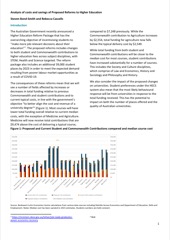
The Australian Government recently announced a Higher Education Reform Package that has the overarching objective of incentivising students to “make more job-relevant decisions about their education”. The proposed reforms includes changes to both student and Commonwealth contributions to higher education fees across subject disciplines, with STEM, Health and Science targeted. The reform package also includes an additional 39,000 student places by 2023 in order to meet the expected demand resulting from poorer labour market opportunities as a result of COVID-19.
The consequences of these reforms mean that we will see a number of fields affected by increases or decreases in total funding relative to previous Commonwealth and student contributions and to current typical costs, in line with the government’s objective “to better align the cost and revenue of a university degree”. Most courses will have lower total funding overall relative to current median costs, with the exception of Medicine and Agriculture. Medicine will now receive total contributions that are $9,474 above the cost of delivering a typical course, compared to $7,248 previously. While the Commonwealth contribution to Agriculture increases by $2,554, total funding for agriculture now falls below the typical delivery cost by $2,549.
While total funding from both student and Commonwealth contributions will be closer to the median cost for most courses, student contributions have increased substantially for a number of courses. This includes the Society and Culture disciplines, which comprise of Law and Economics, History and Sociology and Philosophy and History.
We also consider the impact of the proposed changes on universities. Student preferences under the HECS system also mean that the most likely behavioural response will be from universities in response to the total funding received. This has the potential to impact on both the number of places offered and the quality of Australian universities.
In the pressYahoo! Finance Australia, studyinternational.com, The Mandarin, studyinternational.com, The New Daily
-
Future-proofing the WA economy: A roadmap to industrial diversification and regional growth
BCEC Focus on Industry Series, No. 4, 2019
Project leader.
Summary
Future-Proofing the WA Economy is the fourth report in the Bankwest Curtin Economics Centre’s Focus on Industry report series. The report recommends the implementation of a ‘smart specialisation’ approach to regional diversification, to ensure that new development opportunities build on existing regional capabilities and capitalise on local conditions and networks.
Of course, this doesn’t mean taking our ‘foot off the gas’ in the parts of the economy that are going well. A fundamental element of smart specialisation is to support those industries that the regions are leading in. But the smart specialisation policy is useful to encourage diversification into new industries that build on WA’s existing advantages.
This report contributes an important new evidence base to inform the State’s diversification strategy, based on a data-driven approach to identify current industry strengths and emerging opportunities in each of WA’s ten regions.
The report puts forward a series of recommendations to support the State’s diversification strategies. In doing so, our hope is that more economic development opportunities in Western Australia will be seized rather than lost.
In the pressMandurah Mail, The Fifth Estate, Sydney Morning Herald, nationaltribune.com.au
-

To health and happiness: WA's health industry future
BCEC Focus on Industry Series, No. 3, 2018
Summary
A healthcare system is essential for promoting the health and wellbeing of the population. Whether WA’s health care system is placed to do so is the central question of this third report in BCEC’s Focus on Industry series.
WA’s health sector is growing rapidly, contributing more to the State’s economy in value terms than at any point in its history. Industry GVA for the health and social assistance sector now ranks third across all sectors in WA behind mining and construction. It accounts for an increasingly high share of the State’s employment. This growth notwithstanding, the healthcare industry’s capacity to effectively promote the health and wellbeing of WA’s population remains constrained in several important ways.
Paramount among the issues Australia’s healthcare system faces is the failure to make progress towards bridging the Indigenous-non-Indigenous gaps in health behaviours and outcomes. Access to healthcare is unevenly distributed across our localities, and WA’s remote locations are particularly disadvantaged. The report highlights the constraints around accessing GP services in particular, and suggests that there may be some substitution of primary care services for hospital care as a result.
Our findings also suggest that very little is spent on preventative health initiatives in WA while returns to such investment might be potentially high. Many commonly faced health conditions could be prevented, yet these continue to place pressure on our health system. Unhealthy lifestyle behaviours, including dangerous alcohol consumption, remain widespread in WA, particularly among its indigenous population.
This report also asks whether Australia’s aged care system is placed to ensure the health and wellbeing of its ageing population. We show that current funding is not keeping pace with the demands of the ageing population, resulting in decreases in the number of operational places per capita and increases in waiting times for places over the past years. Additionally, we provide suggestive evidence that personal care workers in residential aged care facilities are being used as substitutes for enrolled nurses; if so this threatens the quality of the services provided by aged care services as well as having negative repercussions for the aged care workforce itself.
To effectively strengthen health systems, the health workforce is of key importance. Our analysis shows that our health workforce is growing rapidly in size, and health sector workers are increasingly more educated – a fact that may contribute towards delivery of higher quality services in the future. However, our analysis also points out at a decrease in the share of very satisfied health workers, and highlights the signs of emerging poor health and psychological distress among them, which may adversely affect the delivery of healthcare services.
Mobile health technologies have great potential to mitigate some of the disadvantage in accessing health services faced by the residents of remote areas in WA. We show that there has been a significant increase in emergency telehealth service consultation in the past 5 years. A vibrant health innovation system, however, requires investment, yet our findings point to under-investment in research in WA relative to comparable jurisdictions in Australia.
-
Falling through the net: The digital divide in Western Australia
BCEC Focus on Western Australia Series, No. 11, 2018
Summary
New data technologies, big data analytics and intelligent software systems are transforming the way we produce, consume or distribute commodities, and increasingly, the way we access services. They are also changing the way in which we engage with our personal, social and business networks and communities.
This BCEC Focus on WA report shows there are clear divides between the haves and have nots, across various measures of access, ability and affordability.
At the household and individual level, we evidence clear differences along geographic, demographic and socio-economic lines, with one in four of the poorest households in Western Australia without access to the internet compared to almost all of the highest income households.
Those most at risk of falling through the net in WA, and of becoming increasingly disconnected from society include: those living in the most remote areas; families at higher levels of socio-economic disadvantage; older population cohorts and low income families, including children at risk of missing out on the educational benefits of ICT.
Analysis of expenditure patterns over time show that digital technologies are a necessity, particularly for those on lower incomes. The newly devised BCEC digital stress indicator identifies those households, by family composition and housing tenure, which are chiefly at risk.
The BCEC Small Business Survey highlights that internet quality and coverage does vary significantly between Western Australia’s regions. The report found 26 per cent of small businesses in the South West and Pilbara regions rated the quality of their internet infrastructure as low, compared with 25 per cent in the Wheatbelt and only 11 per cent in Perth.
-
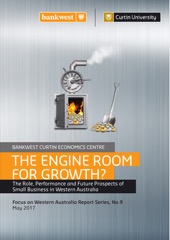
The engine room for growth? The role, performance and future prospects of small business in Western Australia
BCEC Focus on Western Australia Series, No. 9, 2017
Summary
The 2015 Federal Budget referred to small businesses as the ‘engine room’ of the economy. Australia’s changing economic landscape means that governments are placing greater emphasis on the important role of small businesses for growth and employment. This is not unique to Australia, with small firms seen as the driving force of growth across many of the developed OECD nations.
This report examines the history of WA’s small business sector, its current contribution to the WA economy, and the future prospects for small businesses in the state.
We ask if small businesses are in fact the engine room for growth in WA, by looking at their value added and employment contribution to the economy. The factors contributing to and impacting on their survival, growth and succession are addressed.
As of June 2016, small businesses account for around 97 per cent of all businesses in Western Australia. They contribute a staggering $40 billion to the State’s economy in direct value added alone, and employ over 41 per cent of WA’s overall workforce. And yet these figures, impressive as they are, don’t fully capture the great contributions of the small business sector to the State’s economic trajectory. Neither do they recognise the critical role that small business owners play in supporting local communities, especially in regional areas.
Key findings are supported by the BCEC Small Business Survey 2017. With 1,500 small businesses surveyed, this new dataset ensures that the diverse nature of the small business sector in WA, at both a regional and industry level, are adequately captured and represented.
-
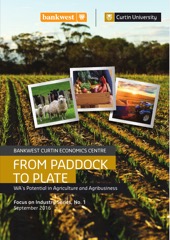
From paddock to plate: WA's potential in agriculture and agribusiness
BCEC Focus on Industry Series, No. 1, 2016
Summary
WA has had a sustained period of continuous economic growth which has been underpinned by the mining and associated industries over the past decade.
As the mining sector slows businesses, investors and the government have been looking for or incentivising new sources of growth and prosperity – the ‘next big thing’. Historically, agribusiness has been important for the Australian and, to a lesser extent, the WA economies. With optimism stemming from a rising middle class in China, which is expected to increase demand for high value food products, and the rising population in Southeast Asia, even greater attention is now being placed in the industry.
The agriculture, forestry and fishing sector currently only contributes 1.8% of the value of the WA economy and 2.3% in terms of employment. Despite the slowdown the mining sector is still contributing 25.6% in terms of value and 8.2% in terms of employment.
Nonetheless, the agribusiness sector in Australia and WA is already providing significant exports to Asia. New niche markets have opened up and the agribusiness sector should continue to search for new opportunities.
Productivity growth could be expected to continue as investment in irrigated agriculture expands and farmers take advantage of new technological developments to optimise farm management. While agribusiness is unlikely to provide the sort of growth that governments and investors are hoping for, the findings in this report indicate that agribusiness continues to provide a cornerstone for growth of the WA economy, particularly in regional WA.
-

Positioned for an ideas boom? Productivity and innovation in Australia
BCEC Focus on the States Series, No. 4, 2016
Summary
Positioned for an Ideas Boom is the fourth report in the Bankwest Curtin Economics Centre Focus on the States series. The report examines an issue of central importance to maintaining economic growth, improving competitiveness and creating jobs – productivity and innovation.
The much anticipated National Innovation and Science Agenda launched by Prime Minister Malcolm Turnbull in December 2015 has committed funding of $1.1 billion over four years to twenty eight action areas, which include de-risking start-ups; investing in STEM; attracting and keeping overseas entrepreneurs; and improving university-industry connectedness, amongst others.
These measures are welcome not just because of the commitment of financial support to innovation programmes, but also because of the important signal that promoting a culture of innovation is essential to Australia’s economic growth and future prosperity.
So is Australia positioned to capitalise on an ideas boom?
It is more important now than ever for Australia to both learn from, and drive, prosperity through international collaborations. Australia has the people, the resources, the environment, the knowledge and the creativity to thrive in the future, and to contribute to national and global economic growth. But significant barriers remain, specifically in relation to access to research and development funding and venture capital investment, especially to smaller enterprises and at early stages of business expansion.
The National Innovation and Science Agenda provides a credible and coherent prospectus of policies, and significant government funding support, to drive productivity and innovation growth in Australia. The opportunity, and the responsibility, falls on us all government, families, businesses, universities and research institutions – to bring the ideas boom to reality.
Forecast reports
Recurring forecasts for the state of Hawaiʻi and its counties, produced with the UHERO forecast team.
-

No respite from storms or oil prices
UHERO Forecast for the State of Hawaiʻi, 2026
In the pressHawaii News Now, Hawaiʻi Public Radio
-
War brings more stormy weather to Hawaiʻi
UHERO Forecast for the State of Hawaiʻi, 2026
In the pressMaui Now
-

Hawaiʻi moves beyond recession, but slowly
UHERO Forecast for the State of Hawaiʻi, 2026
In the pressHonolulu Star-Advertiser, Big Island Video News, Hawaii News Now, Pacific Business News, Hawaiʻi Public Radio, Aloha State Daily
-

Mild recession and weak recovery in 2026
UHERO Forecast for the State of Hawaiʻi, 2025
In the pressMaui Now
-

Deteriorating US outlook weighs on Hawaiʻi prospects
UHERO Forecast for the State of Hawaiʻi, 2025
In the pressThe Maui News, Big Island Video News, Hawaii News Now, Hawaii News Now, Aloha State Daily, Hawaiʻi Free Press
-
Slowing US economy turns Kauaʻi outlook negative
UHERO Forecast for the County of Kauaʻi, 2025
-

Federal policies push Hawaiʻi toward mild recession
UHERO Forecast for the State of Hawaiʻi, 2025
In the pressTravel Weekly, Honolulu Star-Advertiser, KITV, The Business Journals, Hawaii News Now, Spectrum News, Kauaʻi Now, Big Island Video News
-

Federal cuts raise risk of Hawaiʻi downturn
UHERO Forecast for the State of Hawaiʻi, 2025
-

Outlook more uncertain as federal policy changes loom
UHERO Forecast for the State of Hawaiʻi, 2024
-
Lagging Maui recovery and a slower speed limit for Hawaiʻi growth
UHERO Forecast for the State of Hawaiʻi, 2024
-
-
Expansion intact, but counties poised for slower growth
UHERO Forecast for the State of Hawaiʻi, 2024
-

Near-term slowing expected as pandemic recovery ends
UHERO Forecast for the State of Hawaiʻi, 2024
-

State facing headwinds as Maui recovery begins
UHERO Forecast for the State of Hawaiʻi, 2023
-

Maui fires deliver blow to the Valley Isle outlook
UHERO Forecast for the State of Hawaiʻi, 2023
-
Declining US outlook is a rising risk for Kauaʻi
UHERO Forecast for the County of Kauaʻi, 2023
-

Promise and peril for the Hawaiʻi economy
UHERO Forecast for the State of Hawaiʻi, 2023
-

A Hawaiʻi soft landing still in the cards
UHERO Forecast for the State of Hawaiʻi, 2023
-
Global inflation fight will pause Hawaiʻi growth
UHERO Forecast for the State of Hawaiʻi, 2022
-

US recession will weigh on Hawaiʻi's recovery
UHERO Forecast for the State of Hawaiʻi, 2022
-

Foreign visitors will provide boost, but risks have risen
UHERO Forecast for the State of Hawaiʻi, 2022
-

With Omicron in the rearview mirror, a clearer road ahead?
UHERO Forecast for the State of Hawaiʻi, 2022
-

-

Delta wave swamps tourism, but return to recovery expected
UHERO Forecast for the State of Hawaiʻi, 2021
Nothing under this topic.